الاثنين، 27 أبريل 2015

LEAVING TO COME BACK

written for Andariya magazine

A few months ago; Sara, my hair dresser- who holds a degree in law from Omdurman Islamic University- was depressed and out of focus. Her boyfriend had suddenly disappeared and his phone was switched off. A couple of days later, one of his friends relayed the news that the boyfriend was seeking refuge in Europe and found a smuggler who would take him there for a reasonable price. Her boyfriend only left her with a message regretting his misfortune; at being unable to neither find a job nor found a family with her in Sudan.
In April 2014, ten Sudanese men perished from thirst and hunger in the great Sahara desert. They were among a group of 319 illegal migrants (of whom a large number were Sudanese), trying to find their way into Libya. The news splash only lasted a few days, outraging the public and keeping the authorities unrested on the rise of human trafficking operations in Sudan. Yet, we never learned who these illegal migrants were and why they were so desperate to leave; but their stories may not be different from that of Sara’s boyfriend.
*
When I graduated in 2008 I had big dreams of being independent and employed. These dreams were put on hold until I first completed the compulsory civic service internship – 15 months of unpaid work. I had to ask my family to continue paying me a daily allowance, as well as cover the Sudanese medical board registration and exams fees.  Nonetheless, it was not the worst scenario for a fresh graduate.
Years later, I realized that most of my fellow university colleagues and internship co-workers are now immigrants in Gulf countries, Europe and the United States. One of them, a registrar, was suspended from work for participating in the 2010 doctors strike. His monthly salary was 600 SDG with an extra 17 SDG for night shifts. He had a girlfriend and young siblings in schools. Luckily he got an offer to work in Saudi Arabia for 5000 Riyals a month, which saved him from waiting for the work suspension appeal and the economic hardship he lived in. People with certain professions like doctors may find their way out legally. This is not the case for other professions in the spectrum; so many seek salvation through smuggling.
Sudan is becoming a destructive place for young people. Universities are a site for violence and chaos. Graduates find themselves with little besides looming unemployment. To an increasing amount of young graduates and professionals, migration seems to be the only way to build a future and dignified life. The Secretariat of Sudanese Working Abroad, a regulatory governmental entity for Sudanese diaspora reported that 67,000 people migrated in 2014. The photo of hundreds of youth crowded in front of the embassy of Qatar in Khartoum last November was a clear manifestation of the phenomenon.
In 2014, I was granted a scholarship to pursue a one year Master’s degree in the UK. One of the scholarship conditions was to return to Sudan after completing my studies, and work there for at least two years. Extended family members and close friends were asking me whether I planned on returning or seeking asylum. Among many others; a journalist covering a scholarship related event told me “lucky you, you should never go back!”
Before getting this scholarship I contemplated finding a job and moving abroad on numerous occasions. However, I was not brave enough to make such a decision.  So I was deeply offended by people who decided for me to breach my scholarship agreement and seek asylum in the UK, regardless of my life plans and considerations.
I won this scholarship because I had plans to serve my country, not to use it to seek asylum. In Sudan, I was living in a middle class neighborhood in Khartoum and have been employed in public relations, advocacy and social activism for seven years. There are no threats to my life and well being, thus no need to lie and take advantages of my activism. I pursued activism because I could not bear the guilt of living well while millions are starving in displacement camps across Sudan. If anyone needs to seek asylum, it should be those who run away from war. Thousands of people have been living in the camps for years and have no opportunity to leave.
There is an interesting trend; where lack of development and economic growth is forcing qualified professionals to migrate in new waves. In 2012; the minister of finance made a statement that listed doctors among exported Sudanese products. Recently a video of a pro-government representative went viral on social media; she was encouraging youth to migrate claiming that migration is a prophetic practice. Perhaps there’s a grander plot to evacuate the country from any vocally dissatisfied people, like my friend the registrar who appealed his suspension- so it’s easier to dominate the voiceless.
I am planning to go back to Sudan after getting my Master’s degree. I will go back with more academic knowledge and life experiences. I will try to make Sudan a better place for myself, the millions in displacement camps and the forgotten who sacrificed their freedom, time, health and right to live at home. This is not a heroic act but an obligation towards the people who chose to stay, survive and fight for the advancement of society using the resources they have.
I am not suggesting that people should stay in Sudan when the chances for professional and intellectual advancement are slim. Yet I disagree with young diaspora who claim “we left Sudan because it provided us with nothing”, or “we did our best to change the situation but we failed”. Migration is always a personal choice in which one could consider it a runaway plan or a learning opportunity. I see the migration of skilled professionals as a transitional phase in which they get the skills and empowerment to lead in Sudan.

Sudan's anti-dam movement fights the flooding of Nubian culture

Written for the Guardian Africa Network

“The police bombed us with tear gas. I heard the sounds of bullets being shot. I could never imagine they would shoot to kill.”
Abdel Hakim Nasr recalls a protest in 2007 in the small town of Kidentakar, between the mountains and the Nile in northern Sudan, when government forces opened fire against demonstrators opposing a new dam.
The Kajbar dam would have flooded an estimated 90 villages, displacing nearly 10,000 people and destroying more than 500 archeological sites – some dating back thousands of years.
For many, this crackdown in 2007 was a turning point. Activists argued that it was not just about environmental destruction but also the attempted drowning of Nubian culture by a government intolerant of the non-Arab ethnicities that make up Sudan.
Four people were killed and at least 20 injured in the crackdown. Soon after, the government gave up on plans for the dam. But in 2010 residents were horrified to find machinery surveying their land after a contract worth $705m was awarded to the Chinese company Sinohydro, the world’s largest hydropower contractor.
International Rivers, an environmental group which joined locals in opposing the project, predicts that the Kajbar dam on the Nile’s third cataract will be 20 metres high and create a reservoir of around 110 sq km, leading to the further displacement and resettlement of some 10,000 people.

Flushing out


Many local residents feel that the dam project is a way of destroying Nubian heritage by displacing residents and advancing a policy of “Arabisation” across the country, spearheaded by the president, Omar al-Bashir.
In December 2010, weeks before the referendum where southerners chose secession from Khartoum, he made a speech in the south eastern town of Al Qadarif, saying: “If south Sudan secedes, we will change the constitution. Sharia and Islam will be the main source for the constitution, Islam the official religion and Arabic the official language.”
While non-Arab ethnicities in Darfur have been targeted by violence, earning Bashir an indictment for war crimes from The Hague, activists say the dams project is displacement by other means: environmental destruction.
Adham Nasr, a member of the Anti-Kajbar committee, said that the dams were being used to literally “flood Nubian culture” – an insidious way to exclude and alienate non-Arab ethnicities
The government claims that the dams will bring economic development to the region, but Nasr argues this is impossible “after our heritage and culture drown”.

The case of Wadi Halfa and Merowe

Residents didn’t have to guess at the kind of destruction they faced once the dam was approved – they just had to look back. In 1959 in Wadi Halfa, on Sudan’s northern border with Egypt, the controversial Aswan Dam led to the displacement of 52,000 Nubians on both sides of the state line.
Archeologists guess that the project destroyed many ancient relics. The ancient temple Abu Simbel, built by Pharaoh Ramesses II in the 13th century BC, had to be dismantled and relocated to the banks of what was to become Lake Nasser, to avoid being submerged and lost under the dam’s floods.
More recently, the Merowe dam caused similar controversy – and destruction. The project, which cost £1bn and is Africa’s second-largest hydropower project (after Aswan), displaced a further 50,000 people from fertile stretches of the Nile valley to new desert locations between 2003 and 2005.

Other attacks

The independence of the oil-rich south has resulted in economic hardship in Sudan, and has prompted several ill-conceived projects in search of new resources.
The government announced in early 2013 that it had found considerable gold seams in the northern states, prompting a rise in mining projects, both amateur and commercial. The result? Sites of archeological importance were destroyed and high levels of cyanide and mercury found dumped during the extraction process.
There have also been reports of attacks on date palms – the cash crop for Nubians. Used widely across the region for roofing and as cooking fuel, in the past five years Nubians in Kajbar have been losing their trees in suspicious circumstances. The Anti-Kajbar committee says that about 200,000 trees have been destroyed.
“It’s an attempt to displace Nubians through depriving them of their wealth,” said Tag Alkhatim Abdel Ghafour, a political activist originally from Nubia. “Losing a palm tree is a huge loss as it takes 10–15 years to grow and produce dates.
“Now thousands of trees are being lost in each incident. Political parties should pay attention to these abuses and these brazen attempts to destroy the Nubian culture.”
While armed conflicts and civil wars in other parts of Sudan dominate the news, the Nubian struggle is often ignored. Activists fear that the result could be the loss of one of the oldest and most enduring civilisations on Earth.

Sudan and Operation Decisive Storm

first published here

Sudan’s decision to join Operation Decisive Storm with Saudi Arabia and a coalition of Gulf countries to fight Yemeni Houthi rebels comes as no surprise.
The government of Sudan has no limits when it comes to its regional and international allies. Aerial bombardments were one of the techniques being used against people in South Sudan during the 1990s civil war, and more recently in the Darfur Genocide and in the Nuba Mountains and Blue Nile regions. Nuba Reports, who report from the frontlines in South Kordofan, stated that 3470 bombs targeted civilians since April 2012.
Considering Sudan’s history, the government is neither concerned with human rights nor the protection of civilians in Yemen or elsewhere. However, what is surprising is the opposition parties’ overt support for Sudan’s participation in Operation Decisive Storm.
The Sudan Shadow Government is an opposition initiative that aims to provide citizens with alternative ways of opposing the government, in an attempt to evade the conventional ideological clashes that regularly take place. They monitor government performance, and their volunteer ministers suggest alternative pursuable programs.
This time around, the initiative offered no alternatives to taking part in Operation Decisive Storm, which the government claims will improve Sudan’s international relations and economic stance.
A statement issued on the 27 March 2015 did criticize the government for exhausting its limited military resources and urged diplomatic missions to maintain regular contact with Sudanese residents in Yemen. However, the shadow government welcomed military intervention in Yemen on the grounds of breaking Sudan’s regional isolation due to close relations with Iran since 1989.
The shadow government’s statement failed to address the consequences the operation would have on civilians in Yemen, where thousands of Sudanese civilians also reside. On 26 March Altareeq reported that militias had attacked Sudanese families in Yemen. It was only on 31 March that the evacuation of Sudanese started to take place.
What’s odd is that there are concerns for Sudan’s regional legitimacy while the regime’s legitimacy is constantly being questioned by its own people—a regime that came to power through a military coup in a country that has been in endless wars ever since.
Major opposition parties in Sudan boycotted the elections that took place earlier this month, because they are refusing to give the regime legitimacy. However, representatives of National Umma Party (NUP), Sudanese Communist Party and Sudanese Baath Party support the government’s decision to join Operation Decisive Storm.
On the one hand, Mr. Fadlallah Burma Nasir, the vice president of NUP, toldAlsharq Al-Awsat that the operation is taking place to protect Yemen’s legitimate president from rebellion. It is worth noting that NUP has signed a joint agreement with the Revolutionary Front—the Sudanese rebels' coalition. It would be interesting to see how the NUP would react if the Sudanese government called on its allies to eradicate rebellion in Sudan.
On the other hand Mohamed Ali Jadin, leader of the Sudanese Baath Party, cautioned against Iranian intervention. It’s worth noting that the Sudanese Baath Party is ideologically affiliated with that of Syria, which is supported by the Iranian regime in its war against the Syrian people.
Amusingly Jadin described Sudan’s participation in the operation as a step towards fragmenting institutions of political Islam, even though it is clearly being led by Saudi Arabia – the leading pillar of Wahhabism and extremism.
Sudan itself is governed by one of the oldest institutions of political Islam in the region, the Muslim Brotherhood, who took control of the government in 1989.
Sudan’s opposition stance towards Operation Decisive Storm has received a lot of criticism from Sudanese social media users. Some users questioned the Shadow Government’s statement on their Facebook page. While Ahmad, activist and filmmaker, tweeted: “It would have been more appropriate if Siddig Yousif of the communist party announced his solidarity with Yemeni people rather than supporting a military operation”.
The operation has affected hundreds of innocent people in Yemen. Yasin Alqubati, a doctor and political activist from Taaz, posted a photo of a toddler who had been burnt to death urging parties to stop the hostility and save the lives of civilians. Abdel Aziz Baraka Sakin, a novelist and Sudanese writer, commented on the photo with a dark sense of humor: "Maybe this toddler was one of the disbelievers in Yemen," pointing to the government’s justification of joining Operation Decisive Storm to protect Islam in the region.
The solidarity with the people in Yemen being expressed on social media suggests that political boundaries and nationalities are no longer tools for patriotism. The people who experienced, or are even slightly affected, by war are standing firmly against it.
It seems that political parties and initiatives need to learn more about compassion for their fellow human beings, regardless of the diplomatic gains they wish to achieve.
As such, the opposition’s motives to change the regime in Sudan remain questionable since they see no harm in justifying military operations elsewhere

It’s always the woman’s fault

first published here

Women, in Sudan are considered adults once they hit puberty. Men, on the other hand, can still get away with heinous behavior no matter how old they are. In Sudan, for example, even when a girl is gang raped or sexually harassed, it is always her fault. The men, fully aware that they will not be held accountable, continue to violate women on a daily basis, because it is always “the woman’s fault.”
One of the horrific cases is of a 13-year-old Sudanese girl who was raped by a militia. She is being accused and charged with gross indecency, she tried to file for rape, but in order for the case to be processed she would have to bring four witnesses to verify her claim, which, of course, she couldn’t do. Her trial has been transferred from juvenile court to criminal court because she is considered to be an “adult woman”.
According to the Personal Status of Muslims Act of 1991, girls (or boys) can marry at the age of 10, and crimes related to sexual violence against girls mostly get prosecuted in adult criminal courts. There are claims that she had had an affair with her rapist, however untrue, in order to have the case transferred from adultery to gross indecency. Socially she is being accused with being immoral and seducing adult men. The general opinion is that she ruined her own future; nobody cares about how she feels or what she has been through as only she can be blamed for her rape. She has been stigmatized, worth nothing but her broken hymen. Now, it doesn’t matter if she attends school or attempts suicide, she brought it upon herself that 13-year-old “woman.”
Another daily occurrence in Sudan is of women being sexually harassed as they are going about their daily lives. If a woman is walking around in trousers, wearing a tight t-shirt and without a headscarf it can “annoy a man.” Men feel entitle to harass women and may even go so far as to file a case against a woman for wearing “indecent clothing.” On the other hand, if a woman wants to prove that she has been sexually harassed on public transportation, the police will refuse to file a case. If they do agree, then it is most likely that she has “connections”, however, she has to bring witnesses to the act, which is of course impossible, even though at times, harassers will beat a woman up if they are told to stop touching her.
A case that has received a bit more coverage is that of a young pregnant Ethiopian lady who was gang raped, and filmed, by seven men during the Muslim feast (Eid Al Fitr). Soon after the incident, she bumped into a police officer who took her to the police station but failed to file a case. Five months later, she got arrested when the video went viral on Whatsapp.
She is being accused of “practicing” prostitution and possessing indecent materials. While kept under police custody; the attorney general denied her the right to file the rape case as well as bail. He claimed that there is no provision in the law granting her access to the law on this; although there is no provision in the law denying her this right. Later the court refused to let her file her case because the investigation had already taken place on the basis of prostitution and possession of indecent materials. Furthermore, the prosecutor added charges of adultery and gross indecency before transferring the case to the court. Local media was relentless in blaming the Ethiopian “prostitute” who came to Sudan to spread immorality, HIV and destroy the future of Sudanese young men.
“They are just poor kids, she shouldn’t ruin their future and they deserve another chance to be good people. She is just an Ethiopian whore,” said a tea lady selling tea near the court. She cursed her and was also angry that there was a chance the men were going to be punished along with her for committing immoral acts. However, this same tea lady couldn’t say a word to the five police officers who got tea and coffee from her for free. If she were to ask them to pay, she may be charged with disturbing public order, and may be regarded as immoral and a whore herself. However, she was quite ready to be angry at other “immoral women.”
These stories are from the day-to-day lives of women in Sudan. Few make their way into the media. It’s easy for a man to rape a woman and get away with it, but rape survivors have no means to access justice. It’s easy for a man to drag a woman by her hand to the police station and claim that she disturbed public order but a woman has to know “important people” in order to file a case of gross indecency on public transportation against perpetrators. Not only that, in order to prove her case, she may as well ask the harasser to place his hand on her until she can find witnesses for the act. It’s always the woman’s fault.

الثلاثاء، 31 مارس 2015

تعرفوا على أمل: واحدة من تسعمائة ألف


يشهد إقليم جبال النوبة النزاعات منذ ثمانينيات القرن الماضي، عندما إنضم عدد كبير من أبناء الجبال للجيش الشعبي لتحرير السودان ليحاربوا ضد الحكومة المركزية في الخرطوم. شهد الإقليم حرباً مستمرة منذ العام 1991 وحتى 2002 ولكنه تلقى إهتماماً قليلاً من الإعلام والساسة. في يونيو 2011 وقبيل انفصال جنوب السودان إندلعت الحرب مجدداً في الاقليم بين الحكومة والحركة الشعبية لتحرير السودان- شمال وبذلك أصبح خارج نطاق المعونات الإنسانية والإهتمام الإعلامي. رصدت منظمة هيومان رايتس وواتش في 2012 الأشخاص المُهجّرين بسبب الحرب وعددهم تقريباً تسعمائة ألف شخص، كما أعلنت المفوضية السامية للاجئين التابعة للأمم المتحدة في يناير الماضي أن ثلاثة الآف شخص عبروا الحدود لجنوب السودان خلال شهر واحد.

من النادر أن نسمع عن ما يحدث في جبال النوبة خلافاً لأرقام الاشخاص الفارين من النزاع، أو تسجيلات فيديو للقصف الجوي والأجساد الممزقة. هؤلاء التسعمائة ألف شخص لديهم حكاوى حياتية يجب أن تروى ولديهم وجوه يجب أن يراها السودانيون الذين ينعمون بالسلام، وللعالم الذي لم يكف عن ترديد "لن تحدث الابادة مجدداً" ولكن يغض الطرف عن عدد من النزاعات المدمرة مثل الحرب الدائرة بلا نهاية في السودان.

في هذه السلسلة "واحد/ة من تسعمائة ألف" أحاول أن أعكس حياة النساء والرجال الذين يعيشون في معسكرات النزوح وفي المناطق التي يسيطر عليها التمرد.

الأسماء تم تغييرها لضمان سرية وسلامة من أجريت معهم المقابلات.


تعرفوا على أمل


أمل ناشطة حقوقية وخريجة جامعية في منتصف الثلاثينيات من العمر. تعيش في قريتها الأم وهي قرية صغيرة في محلية أم دورين التي تسيطر عليها الحركة الشعبية لتحرير السودان- شمال. تعمل أمل برصد انتهاكات حقوق الإنسان ونشر الوعي الحقوقي في مجتمعها لصالح منظمة محلية وهي مفتونة بجمال قريتها خاصة في فصل الخريف حيث يكتسي المكان باللون الأخضر. ولكن بالرغم من جمال الطبيعة يعاني الإقليم من الحرب وعدم التنمية ، خاصة المناطق التي تسيطر عليها الحركة الشعبية والتي تتعرض في أغلب الأحيان للقصف الجوي بواسطة قوات الحكومة. تقول أمل:

أصبح الناس يعيشون في الكهوف والجبال ولا تصلهم المعونات الإنسانية، توجد حركة سكانية كبيرة للبلدان المجاورة. في واحدة من الخمس وحدات الأدارية التابعة لأم دورين تم إغلاق كل المدارس بسبب القصف، بينما أغلقت نصف المدارس في وحدتين أخريات. كما أن الذخائر التي لم تنفجر تسببت بتلوث البيئة وخاصة مصادر المياه. لقد تعطل عدد كبير من مضخات المياه وأصبح الناس يعتمدون على الحفر للحصول على المياه الجوفية، التي أصبح لونها بنياً من التلوث وتسبب لهم الأمراض، لقد مرضت عدة مرات من شرب هذه المياه الملوثة، هذا بخلاف عدم توفر الخدمات الصحية والأدوية


حياة أمل لم تكن سلسة سابقاً؛ ففي بداية التسعينات، كانت تعيش في الخرطوم مع والديها وثمانية من أشقائها عندما اندلعت الحرب في جنوب كردفان. مرتب والدها الشهري كان بالكاد يكفيهم عندما أصبح عليهم استقبال عدد كبير من أهلهم الذين تركوا قراهم وفقدوا حياتهم الآمنة وسبل معيشتهم ونزحوا للخرطوم. وتقول:

عانت أسرتي من توفير مصروفات دراستنا، وكان أدائي الاكاديمي متدهوراً، لقد كانت فترة عصيبة علينا


تشتتت عائلة أمل مع اندلاع الحرب في٢٠١١، في حين بقيت والدتها في أم دورين، إنتقل والدها الى جنوب السودان، عدد من إخوتها اتجهوا للخرطوم والمدن الشمالية وبعضهم في معسكر كاكوما بكينيا ولديها أخ في يوغندا.

والداي لم يلتقيا منذ مدة، ويجب أن يكونو معاً برفقة أبنائهم ليراعوهم، ولكن من الصعب تنفيذ ذلك مع الدخل المحدود الذي نجنيه أنا ووالدتي ووالدي. يحتاج أشقائي للرعاية والتوجيه فهم صغار في السن ومراهقين. إثنتين من أخواتي يواجهن مشاكل دائمة وقد تم تحميلهن بينما هربت أختي الصغيرة الى الخرطوم لوحدها لتبحث عن تعليم أفضل أو تسافر لتنضم لأختي الكبيرة في أمريكا. أختي الكبيرة لم تتمكن من زيارتنا منذ غادرت في عام 1999 كما أنها تعاني من توفير معيشتها اليومية في أمريكا. أتمنى لو كنت قادرة على العناية بأخواتي.

تعمل أمل منذ تخرجها في 2010 مع منظمات غير ربحية دولية ومحلية تعني بالتنمية وحقوق الانسان في جبال النوبة، وهي شغوفة بالدفاع عن حقوق الانسان ومناصرة الضحايا وتمكينهم لأخذ حقوقهم. هذا الشغف والإلتزام يمكنها من تحمل التحديات اليومية التي تواجهها لكونها إمرأة عازبة وناشطة تعمل في منطقة نزاع. وتحكي لنا:

بالرغم من أن المجتمع يتغير الا أن التنميط موجود، حيث الأدوار النوعية معرفة ومحددة، ويتوقع من المرأة أن تقوم بأدوار محددة فقط ولذلك تعرضت لكثير من المواقف الصعبة ليس فقط في التعامل مع المجتمع ولكن حتى مع زملاء العمل. بعض الزملاء يشعرون بالتهديد في كل مرة آتي بفكرة جديدة أوأتخذ دوراً قيادياً، احياناً أسمع أنها إمرأة، الزملاء من الرجال أجدر بالقيادة. هذا يزعجني كثيراً لأنني دائماً أساند زملائي كما أنني أكثر مهارة منهم في العمل ومعتادة على تحمل الضغوطات ولكنهم لا يتقبلون هذه الحقائق

تتصور أمل المستقبل المثالي للنساء في السودان، وتتمنى أن تتعلم كل النساء، حتى الكبيرات في السن اللاتي لم يلتحقن بالمدارس يمكنهم أن ينضممن لفصول محو الأمية ليتعلمن القراءة والكتابة، وتقول: 

على النساء تولي أدوار ووظائف صناعة القرار، عليهم تمثيل أخواتهن وأن يكن مؤهلات لهذا التمثيل ولا يضطهدن النساء أبداً. النساء اللاتي شهدن الحرب أظهرن وأثبتن مقدرتهن على أداء كل الأدوار المعرفة اجتماعياً للنساء والرجال

أمل متفائلة بمستقبل السودان وخاصة جبال النوبة حيث تعتقد أن المجتمع منظم وواعي سياسياً:

تنتظرنا أوقات جيدة، سيصبح السودان دولة ديموقراطية حيث لا مكان لظلم قبيلة أو إثنية وسيتمتع كل الناس بحقوق متساوية

لكن تراودها الحيرة والشك عندما تتحدث عن مستقبلها الشخصي:

لست متأكدة، كل شي يعتمد على الظروف، اعتقدت قبل سنوات عديدة أنني سأفعل أشياء كثيرة مثل الإلتحاق بالدراسات العليا. إعتقدت أنني سأتمتع بحياة أسرية مع والدي وإخوتي ولكن حدث العكس. أنا لست سعيدة ولكنني متفائلة أحس بأنني أقوى الآن بالرغم من كل التحديات التي أواجهها. لقد شكلت هذه التحديات شخصيتي واكتسبت المرونة والتحمل. إنني أؤمن أن كل شئ يحدث في ميعاده. سأنطلق لتحقيق أحلامي وخدمة مجتمعي المحلي وكل العالم عندما أكون مستعدة لذلك. لقد طوّرت شعوراً بالتضامن العالمي مع الناس

تبعث أمل كلمة أخيرة لشباب السودان:

تفاءلوا، لا تفقدوا الأمل، فكروا وأعملو، لقد ظُلم الناس وأصبحوا ضحية لنزاعات مستمرة بدأت منذ سنين بعيدة ولكن علينا أن نجد لها حلول جذرية لنمنع حدوثها مرة أخرى. لا يوجد شخص عديم القوة، كلنا لدينا مسئولياتنا وقوانا، فقط علينا أن نلتزم بالعمل وسوف ننجح في تحقيق أهدافنا. لا يهم كم من الزمن يقتضي ذلك لأنه في النهاية لا شئ مستحيل

وتخاطب المجتمع الدولي:

يمكن للمصالح أن تؤخر محاسبة المجرمين، ولكنني أؤمن أن المحكمة الجنائية الدولية عليها أن تقوم بعملها وإلا فما الفائدة من إنشائها
ـــــــــــــــــــــــــــــــــــــــــــــــــــــــــــــــــــــــــــــــــــــــــــــــــــــــــــــــــــــــــــــــــــــــــــــــــــــــــــــــــــــــــــــــــــــــــــــــ 

للحصول على النسخة الانجليزية من هذا المقال اضغط هنا


الجمعة، 27 مارس 2015

Meet Amel: One of the 900,000


The history of Nuba Mountains being a conflict zone dates back to 1980s when many people in the region started to join the SPLA (Sudan People’s Liberation Army) and fighting against the central government in Khartoum. The region has witnessed war from 1991- 2002 but received less attention. The war broke out again between the government and SPLM-N (Sudan People’s Liberation Army/Movement- North)  in June 2011 at the time of the succession of South Sudan. Since then the region is out of reach of humanitarian assistance and off the media radar. In 2012 human rights watch reported that 900000 persons were displaced by the conflict. Recently in January 2015; the UNHCR reported that 3000 persons have crossed to South Sudan in a month. Beside those figures of people escaping the conflict and videos of aerial bombardment and lynched bodies, it is rare to hear any stories from Nuba Mountains. 

But those 900,000 individuals have their life stories that need to be told. They have faces need to be shown to their fellow citizens living in peace and to a world keep saying "never again" but turning a blind eye on many devastating conflicts like the ongoing and endless war in Sudan.
In this series "One of the 900000"; I am trying to reflect on the lives of young women and men living in displacement camps and rebel held areas.  
**Names have been changed to ensure the anonymity and safety of the interviewees.

Meet Amel


Amel is an activist, a university graduate in her mid-thirties. She lives in her home town; a small village in Umdorain County in Nuba Mountains which is controlled by SPLM-N. She works with a local organization on monitoring human rights violations and educating her community on the issue. She likes the beauty of her home town especially during rainy season; when the surroundings; including the mountains cover with green.

Amel testifies that; in spite of the beauty of the rainy season; the region is troubled by war and under development; especially SPLM-N controlled areas which is suffering from frequent areal strikes by government forces. 
 "Now people are living in caves and mountains with no access to humanitarian relief. There is a huge population movement to the neighboring countries. One of the five administrative units in Umdorain has all its schools closed because of the shelling while two other units closed down half of their schools. Furthermore; shelling has polluted the environment. The water sources have been heavily polluted by the unexploded ordnance. Many manual water pumps are not working now. People are relying on groundwater which recently turned brownish. It is causing them diseases; even I got sick several times from drinking it. Not to mention the shortage in health facilities and medicines" she says.

Amel’s life has not been easy. In the early 1990s she was living with her parents and 8 siblings in Khartoum when the war broke out in South Kordofan. Their father’s salary were barely enough for them when they have to host new comers who fled their home to Khartoum, losing their livelihood and the joy of living in peace. 
"My family struggled with providing our education fees and my academic performance was poor. It was a hard time for us"

Now after the eruption of war in June 2011; her family is being divided. While her mother is living in Umdorain; her father is in South Sudan. Some of her siblings moved to Khartoum and Northern cities, others seek refuge in Kakuma refugee camp in Kenya and one is living in Uganda.
"My parents have not been together in a while; they need to be together, with their children and look after them. However this is hard to be achieved now with the little income that I, my father and my mother make. My siblings are very young; they are teenagers and need guidance and direction. Two of my sisters are constantly get into troubles and they got impregnated. My youngest sister run to Khartoum alone seeking a good education or away to join my elder sister in the U.S. who's herself is struggling with maintaining daily living and we could not see her since 1999. I wish if I was there taking care of my sisters"

Since her graduation in 2010; Amel has been working in Nuba Mountains with international and national nonprofit organizations that works on development and human rights. She is passionate about defending human rights, standing by the side of victims and empowering them to claim their rights. This passion and commitment is enabling her to bear the daily challenges of being a single woman and an activist in war zone. She narrates:
"Although the social dynamics of the community is changing still many stereotypes persist. The gender roles are tightly defined. A woman is expected to do certain predestined jobs. I have been into some difficult situations not only when dealing with local communities, but even with my work mates. Some colleagues feel intimidated whenever I come up with new ideas or assume a leading role. I usually hear comments like "she is a woman; the male colleagues must be taking the lead". This just pisses me off; I am always supporting my colleagues. I am more skilled than them and I am used to work under pressure but they cannot tolerate those facts"

Amel envisions the ideal future of women in Sudan. She hopes all women could be educated; even the elders who did not go to schools can join literacy classes to be able to read and write. 
"Women should assume decision making roles and jobs. They should represent their sisters, be qualified for this representation and never oppress women. Women who survived the war have shown potentials of conducting both men and women predefined social roles"

Amel is optimistic when it comes to the future of Sudan and specifically Nuba Mountains region. She thinks the society is well organized and politically aware:
 "Good times are waiting for us. Sudan will be a democratic country where there is no tribe or ethnicity be grieved and people will enjoy equal rights"
But when it comes to her personal future; uncertainty evolves:
"I am not sure, and all depends on the circumstances. Few years ago, I thought that I will be doing a lot of things like pursuing postgraduate studies. I thought I will enjoy family life and be with my parents and siblings but the opposite has happened. I am not happy but keeping optimism. I feel much stronger now; in spite of all the challenges of being a woman; living in a war zone has shaped my personality; I acquired flexibility. I believe everything happen in its meant time. Whenever I get ready I will go for my dreams and serve the community locally, nationally and internationally. I have developed a sense of global solidarity with people"
Amel sends a final word to the youth of Sudan:
"Do not lose hope, be optimistic, think and act. People have been victimized by continuous conflicts that started many years ago. We have to come up with a radical solution to prevent its re-occurrence. Nobody is powerless; we all have responsibilities and potential powers. We need to be committed to actions and we should succeed. No matter how long does it take, nothing is impossible"
And she addresses the International community:

"Interests might delay holding criminals accountable. However I still believe that ICC should get its work done otherwise I wonder what should be the benefits of its establishment"
ــــــــــــــــــــــــــــــــــــــــــــــــــــــــــــــــــــــــــــــــــــــــــــــــــــــــــــــــــــــــــــــــــــــــــــــــــــــــــــــــــــــــــــــــــــــــــــ

for the Arabic version of this article follow this link 

الأربعاء، 11 مارس 2015

اسكت يا مرة: كراهية النساء في خطاب الصحفي حسن اسماعيل

حأكتب عن هذه الظاهرة (حسن اسماعيل) ما عشان شناعة الوصف، لكن عشان وجود نمط وتكرار في استخدام التعابير الكارهة للنساء في كلامو وكتاباتو،...

ظاهرة كراهية النساء ما حصرية على حسن اسماعيل، لكن هو أكتر مثال واضح في صفوف الصحفيين والنشطاء المعارضين.

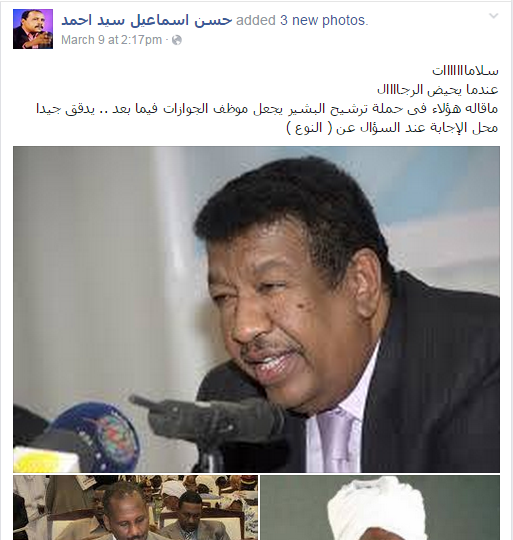
يوم 9 مارس نشر الصحفي حسن اسماعيل في صفحته في فيسبوك البوست التالي:

عندما يحيض الرجال
ما قاله هؤلاء في حملة ترشيح البشير يجعل موظف الجوازات فيما بعد يدقق جيداً محل الاجابة عن سؤال النوع

في كناية الى ذم جلال يوسف الدقير، عبدالرحمن الصادق المهدي مساعدي رئيس الجمهورية.
 
الشتيمة عند حسن اسماعيل هي عدم الذكورة، لو انت ما ذكر فانت أكيد ما عندك اخلاق
و قياساً على ذلك، كل ما هو أنثوي زي الحيض مذموم ومنتقص..

استنكر عدد من متابعي ومتابعات الصحفي حسن اسماعيل استخدامه الحيض كمذمة وسُبة لمناصري المؤتمر الوطني، ووضحوا أنو الأنوثة لا تتنافى مع الاخلاق الحميدة وإنه احتمال أساء التعبير أو استخدام المفردة...

لكن حسن أصر على موقفه وعلق:
نسينا أن نعتذر للنساء ولكن التعبير مفهوم، فالمقصود ليس الاشارة لمنقصة المرأة ولكن المقصود عندما يحني الرجل ظهره للآخرين مقابل وظيفة أو جاه أو أياً كان المقابل.. فعذراً لنون النسوة

جات تكحلا عمتها
حسن اسماعيل في محاولته لتوضيح استخدامه الحيض كمذمة، تمادي في التعبير عن كراهية النساء

تحليل التعليق الفات بيقول لي

ان تذم الرجل بأنه امرأة تحيض ليس عيباً لانك فقط تصف هذا الرجل بأنه انحنى وقبل بالذل ليحصل على مبتغاه... اذاً من صفات المرأة انها تنحني وتقبل الذل للحصول على ما تريد

وتوالت التوضيحات
يليق بالانثى ويجمل وصفها ولكنه منقصة في حق الرجال... الكلام وااااضح

في التعليق/ التوضيح دا استخدم الكاتب صفات بيولوجية وأرفقها بلفظ الأنثى، لكن في المقابل استخدم الوصف الإجتماعي للذكر (الرجل) وما يحمله التعبير من أدوار اجتماعية

فالأنثى البتحيض ما ممكن تتسم بصفات زي الكرامة واحترام الذات، الصفات الحصرية للرجولة زي ما حددها المجتمع الذكوري، وزي ما قال حسن (الكلام وااااضح)

ملاحظة جانبية: واضح انو الكاتب ما انتبه في دروس الأحياء فليست كل الإناث تحيض، والما بتحيض بيولوجياً ما (أنثى) ناقصة، بالتالي الحيض ما (مجمل للإناث)

اشكرك حبيبنا ... نحن شعب نعاف الرجل الذي يبيع كبرياءه ويقف لينافق رجلاً آخر ودة القلناهو

حسن مُصِرْ!!!
للتذكير، حسن شتم الناس الاتكلمو عن ترشيح البشير ووصمهم بالحيض في اشارة لأنوثتهم ونفي رجولتهم، لكن للأسف الناس المعترضة على مذمة الحيض ما فهموا المقصود (أو فهموا صح)

الكاتب منح نفسه حق التحدث بإسم الشعب، الشعب الراجل البيشمئز من الرجال الحائضين، لأنهم منافقين وليس لديهم كبرياء، زي النسوان
لسة ما فهمتو حسن داير يقول شنو؟؟

أسكت يا مرة


وفي بوست تاني، بعد ساعات بسيطة من الإشمئزاز من الحيض والنفاق والذلة، حسن قرر يشتم مصطفى عثمان اسماعيل

نحن أي شتيمة من رجال المؤتمر الوطني بنقبلا
لكن
نحن فارزين الكيمان
قيادات المؤتمر الوطني في كوم يقيفو لينا في صف
وناس مشاعر الدولب ومصطفى عثمان يقيفو في صف

حسن اسماعيل متمسك بشتيمة المؤتمر الوطني ولا النساء ما معروف!!

مصطفى عثمان كان شايل اولويز، الظاهر بيحيض، ياللعار ما راجل، ولا بيحق ليه يتكلم عن المعارضة، شتيمته غير مقبولة لأنه في صف النساء...

حسن اسماعيل عضو حزب الأمة النائبة رئيسه وأمينه العام نساء، ما عندو مشكلة في أنه يفرز الكيمان ويسكت النسوان والمذموميين من الرجال لأنهم نسوان

حسن بقبل الشتيمة بس من رجال المؤتمر الوطني
ولسان حالو لمصطفى عثمان (اسكت يا مرة)

النساء ما ضمن القيادات، القيادة دايماً من الرجال،...

وكل قيادة فاشلة معناها: بتحيض، عديمة الكبرياء، بتنحني مقابل الوصول لمبتغاها، بتبيع كبريائها، منافقة..

الفشل وعدم الأخلاق والمذمة عند حسن اسماعيل بالضرورة أنثى.
الكلام دة ما جديد عليهو

في تأبين الشهيد صلاح سنهوري 2013، حسن اسماعيل خاطب الحضور وقال:
النظام دة يا هو يقعد ونحن نلبس طرح ونخش في بيوتنا ندي قروشنا يا هو يمش

اسقاط النظام عندو مربوط برضو بالرجولة، 
النسوان عندو لابسات طرح، مكانن البيت، خانعات ومستكينات، بيتحقروا وما بيطالبو بي حقهن

حسن اسماعيل لمن قال كلامو دة نسى انو في نسوان استشهدن في سبتمبر في الشارع ما جوة البيوت،...

نسى انو في معتقلات اعتقلوهن من الشارع ما من المطبخ،...

نسى ستات الشاي، النازحات، الناشطات، الآف النسوان والبنات البيتجلدوا كل يوم عشان ما دايرين (يلبسو طرح)، النسوان الكل يوم بيصارعو وبيقالعو حقهن من النظام.

النسوان ديل بي طرحهن أو عدمها هن الحيسقطن نظام الكيزان، وأي نظام تكون فيهو كلمة مرة نبذة.